HIMSS 2026: Rethinking Specimen Chain of Custody at Enterprise Scale

For years, specimen tracking improvements were treated as incremental upgrades. A labeling enhancement. A manual reconciliation step. A barcode expansion inside a single department.

That incremental approach is no longer sufficient.

As health systems grow more complex, the specimen journey now crosses operating rooms, procedural areas, couriers, laboratory accessioning, pathology, and enterprise reporting systems. Each handoff introduces risk. Each manual validation step introduces variability.

At HIMSS 2026, ID Integration will be in the Zebra Technologies Pavilion at Booth #2435 to engage in a deeper discussion: how to build specimen continuity infrastructure that scales across departments, campuses, and health systems.

The Rising Stakes of Specimen Integrity

Specimen management is no longer just a laboratory concern. It is an enterprise risk issue.

Health systems today face:

It requires automated validation at the moments that matter most.

A single specimen error can trigger procedure delays, repeat testing, compliance exposure, and reputational damage that far exceeds the cost of prevention. As health systems expand across campuses and outpatient settings, the probability of chain-of-custody gaps increases unless visibility is deliberately engineered.

Enterprise continuity is no longer a best practice. It is a safeguard.

What Modern Specimen Continuity Requires

Enterprise-grade specimen tracking is not simply about labeling. It is about designing a verifiable, integrated chain of custody from collection through final disposition.

At HIMSS, we will be discussing the structural components required to support that model:

Automated Handoff Verification
Passive RFID enables confirmation at key transition points without adding scanning burden to already strained clinical teams.

Real-Time Exception Visibility
Rather than discovering gaps retrospectively, modern systems surface discrepancies as they occur.

Integration with Clinical and Laboratory Systems
Chain-of-custody events must flow seamlessly into LIS, EHR, and enterprise reporting platforms. Visibility isolated from core systems creates more fragmentation, not less.

Scalable Architecture
Solutions must support multi-campus expansion and evolving regulatory expectations without forcing organizations to redesign workflows every two years.

Beyond Pilot Programs
Many hospitals have implemented departmental specimen tracking initiatives with good intent. Fewer have successfully extended those models across perioperative services, pathology, and satellite facilities.

Scaling requires more than tags and readers. It demands:

Technology deployed without structural planning often results in stalled initiatives or parallel systems that never fully integrate.

At HIMSS 2026, our conversations will center on how to avoid that pattern — and how to design specimen tracking programs that mature alongside the organization.

A Strategic Discussion at HIMSS

Specimen integrity directly impacts patient safety, diagnostic accuracy, and institutional credibility.

If your organization is evaluating long-term improvements in perioperative-to-lab continuity, we welcome the opportunity to discuss what durable, integrated specimen visibility looks like in practice.

You can find ID Integration in the Zebra Technologies Pavilion at Booth #2435.

Let’s move the conversation from incremental fixes to enterprise-grade continuity.

Expanding the Specimen Visibility Conversation

Specimen tracking does not operate in isolation. It intersects with surgical workflows, sterile processing, asset movement, and enterprise data architecture.

If you are exploring broader modernization initiatives, these related resources may provide additional context:

Pre-Analytic Specimen Error Reduction

Why Hospital Tracking Programs Stall — and How to Scale Without Starting Over

Track & Trace Transformation Summit 2026: Why This Moment Matters

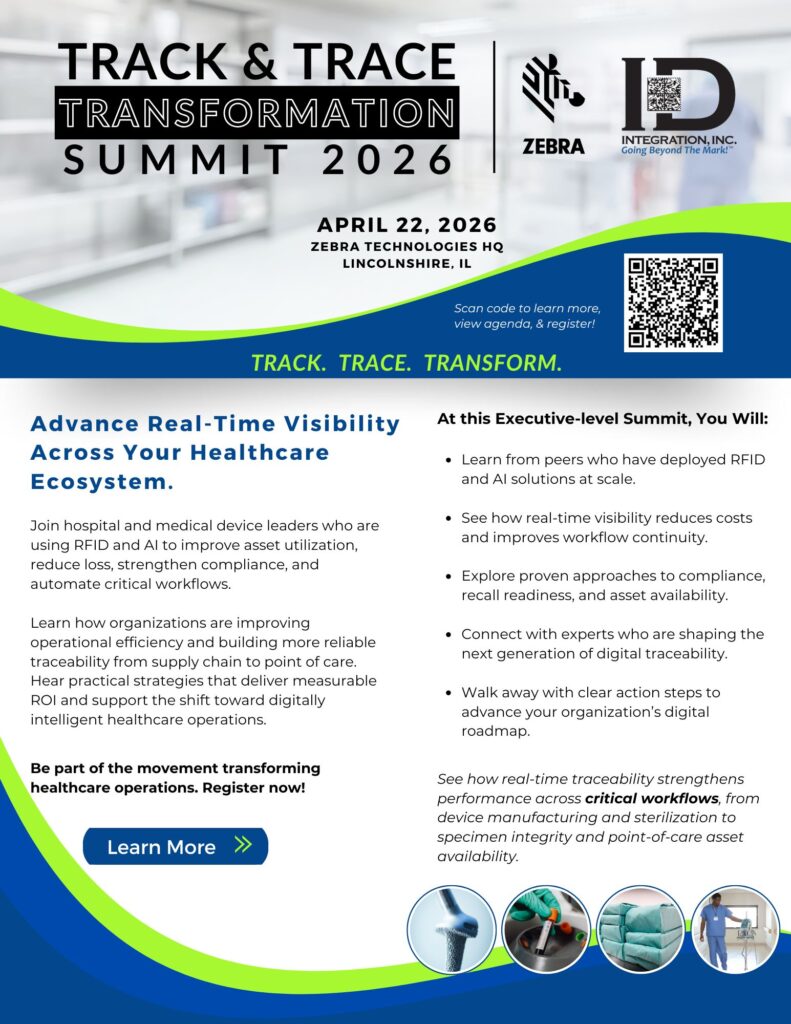
Real-time visibility is no longer a nice-to-have. It is the backbone of safer care, stronger compliance, and smarter operations. On April 22, 2026, leaders from hospitals and medical device manufacturers will convene in Lincolnshire, Illinois, for a focused, executive-level day on practical track and trace—how to move from isolated pilots to outcomes you can measure across trays, equipment, and specimens.

What This Summit Is (And Isn’t)

This is a working forum, not a vendor roadshow. You will hear candid lessons from teams that have implemented passive RFID, analytics, and lightweight integrations with EHR, LIS, and CMMS to remove manual steps and close visibility gaps. The emphasis is on governance, rollout patterns, and KPIs that finance and operations can align around.

Who Should Attend

Why Now

Budgets are tight, expectations are rising, and manual reconciliation cannot keep pace with surgical volume, network growth, and accreditation demands. Facilities and manufacturers that standardize identifiers, automate custody, and publish concise readiness signals are cutting delays, reducing loss, and improving capital efficiency.

Key Themes We’ll Tackle

Moving From Pilots To Programs
How to structure a 90-day proof that survives contact with the OR schedule, the lab bench, and the ED corridor—and then scale without adding staff burden.

Practical Passive RFID
Where passive tags and fixed read zones deliver the most lift-to-cost, when handheld proximity search closes the loop, and how barcodes remain the clinical label.

Data That Becomes Action
Patterns for writing succinct time-and-place events into EHR/LIS/CMMS. Make readiness and custody visible without flooding systems with noise.

Governance, Security, And Support
Role-based access, non-PHI identifiers, audit trails, and the operational agreements that keep read rates healthy and dashboards trusted over time.

Manufacturer–Provider Collaboration
How tray readiness and location class can be shared securely between hospitals, distributors, and manufacturers—improving turnarounds and reducing sterilization redundancy without exposing patient context.

What You’ll Take Home

Event Details

Date: April 22, 2026
Location: Zebra Technologies Headquarters, Lincolnshire, Illinois
Format: Executive briefings, practitioner panels, and hands-on demos with Q&A
Cost: Free (space is limited)

How To Get The Most Value From The Day

Reserve Your Seat

Registration is complimentary, but capacity is capped to enable meaningful discussion. Secure your seat now and join peers who are turning visibility into measurable results.

Questions before you register? Our team is happy to help you determine if the Summit fits your goals and where to start. Call (425) 438-2533.

Closing the Gaps in the OR: Specimen Chain of Custody Without Added Burden

The OR is High-Stakes for Specimens

In the operating room, every sample represents a diagnosis decision, a treatment plan, and a patient’s trust. Yet OR environments are noisy and time-compressed—exactly where mislabeled containers, incomplete requisitions, and missed handoffs can creep in. Research has shown that surgical specimen identification errors are a measurable quality issue in surgical care, rooted largely in communication failures and handoff gaps.

(Source: Makary, Martin A et al. “Surgical specimen identification errors: a new measure of quality in surgical care.” Surgery vol. 141,4 (2007): 450-5. doi:10.1016/j.surg.2006.08.018; Bellini A, Salcedo ES. A Double “Never Event”: Wrong Patient and Wrong Side…PSNet. Rockville (MD): Agency for Healthcare Research and Quality, US Department of Health and Human Services. 2023.)

This article outlines where breakdowns happen and how to add a reliable chain of custody using passive RFID so teams get evidence, not extra work.

Where OR Workflows Break Down

What Good Looks Like In the OR

The correct label prints at the point of collection with human-readable text and machine-readable data, and a non-PHI RFID identifier is bound to the lab order so a unique key follows the specimen. Doorway and threshold reads create automatic custody events without interrupting the case, while handhelds enable proximity search in seconds if something goes missing. At receiving, expected-versus-received reconciliation runs automatically and exceptions become clear tasks, reducing delays and rework. Evidence from multi-site quality studies suggests that catching errors earlier in the pre-analytic path reduces downstream adverse events and rework. (Source: CAP Q-Probes; AHRQ PSNet)

Why Passive RFID Is The OR’s Best Lift-To-Value Option

Automates Specimen Chain of Custody Without Extra Steps

Battery-free tags are read in bulk without line of sight at doorways, hall ceilings, and lab thresholds.

Speeds Recovery of Lost or Misplaced Specimens

Handheld readers guide staff by signal strength to “last-seen” zones, even through sealed containers and inside coolers.

Protects Privacy

Tags carry a non-PHI key that links to the LIS order in the system, so PHI stays where it belongs.

Works With What You Have

Barcode remains the clinical label. RFID adds time and place events that you cannot get from manual scans.

Raises Audit Confidence

Automatic departure and arrival events, plus reconciliation at receiving, create a defensible trail for surveys and accreditation.

A Simple OR-To-Lab Pattern for OR Specimen Tracking

At Collection: Print the label, apply the RFID-enabled sticker in the correct orientation, and confirm the LIS order link.

Handoff Out Of The Room: A fixed reader at the OR or sub-sterile threshold captures departure to staging.

Bag or Cooler Association: A quick bench read or handheld step records which orders are inside a container for transport.

Arrival at Receiving: A fixed reader logs entry, reads contents, and auto-reconciles expected versus received.

Exception Handling: If a timer expires or reconciliation flags a gap, use a handheld to search likely locations along the route or in cold storage.

90-Day OR Rollout Playbook

Weeks 1–3: Design And Validate. Choose one high-volume specimen type and two to three busiest ORs. Place readers at sub-sterile thresholds and lab receiving. Validate label placement for liquids and cooled items.

Weeks 4–6: Train And Go Live. OR circulators and couriers learn the minimal steps. Turn on expected-versus-received reconciliation and route timers.

Weeks 7–10: Tune And Expand. Add unit exit reads for common courier paths. Review exceptions weekly and adjust read zones to raise capture rates.

Weeks 11–13: Operationalize. Publish early KPIs, add handheld recovery to charge nurse desks, and extend to additional rooms or specimen classes.

KPIs That Show Impact

Safety, Quality, And Time Back To Care

The OR needs fewer manual touches, not more. Passive RFID in the OR does the heavy lifting in the background, creating a clear trail from the moment a specimen leaves the room to the moment it is accessioned. That reduces delays, strengthens compliance, and gives clinicians confidence that every sample arrives intact and on time. Findings from CAP and other surgical pathology reviews reinforce that improving the earliest steps in the process has an outsized impact on safety and outcomes.

(Source: CAP Q-Probes; Layfield & Anderson, AJCP, 2010)