POWERED BY ID INTEGRATION, INC.

Specimen Tracking Compliance & Audit Readiness

Who This Is For

Laboratory leaders, quality and accreditation teams, pathology operations, and compliance owners who need complete, searchable documentation of specimen movement and handling. Also relevant to risk management and IT security teams responsible for privacy, access control, and data retention.

What Success Looks Like

  • Inspectors can trace any specimen from order to accessioning in minutes
  • Temperature compliance is recorded and visible for cooled or frozen items
  • Exceptions are documented with correction notes and timestamps
  • Access is role based and auditable, with clear retention policies
  • Reconciliation at receiving shows expected vs. received with gaps resolved the same shift

The Problem We Are Actually Solving

Paper logs and barcode-only spot checks leave blind spots between handoffs. When an auditor asks for evidence, teams scramble to reconstruct what happened. The result is risk: delayed findings, avoidable re-collections, and exposure to claims. A defensible record requires automated custody points, simple exception handling, and a privacy model that keeps PHI in the LIS while still linking events to the correct order.

The Compliance Playbook

Make movement visible
Use automated time and place events at practical handoffs to show departure, arrival, and last-seen status.

Reconcile and alert
Compare expected vs. received on arrival. Open and track tasks for missing or unexpected items.

Capture cold chain
Record temperature pass or fail alongside custody events for items that require control.

Document exceptions
Record relabels, damaged containers, unreadable tags, and corrections with user, time, and reason.

Prove governance
Apply role based access, audit logs, retention rules, and change control. Keep PHI in LIS and use non-PHI keys on tags.

Technology Options That Help

Identifiers

Barcode or 2D code remains the clinical label. Add passive RFID so items are captured automatically at handoffs and recoverable by proximity search. Tags carry non-PHI keys that link to LIS orders.

RFID Fixed Readers

Place at unit exits, dispatch hubs, pneumatic tube send and receive points, lab receiving, cold storage doors, and overhead mounts in hallways. These generate reliable departure and arrival events without extra staff steps.

RFID Handhelds

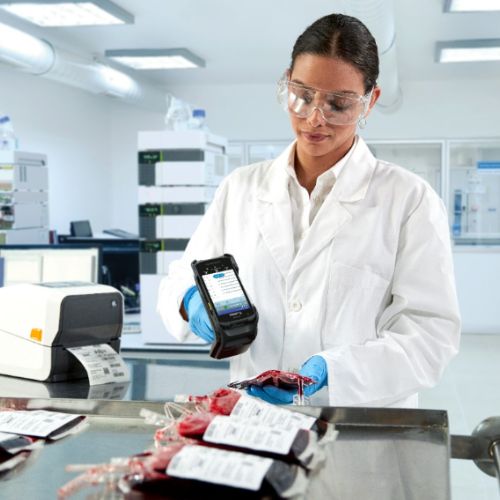
Use for bag or cooler association at pickup, quick proximity search, ad hoc audits, and documenting corrections. Handhelds are useful for finds inside refrigerators and freezers.

Cold Chain Sensors

Place small loggers in cooled or frozen carriers. Post a pass or fail result at receiving and retain full logs where policy requires it.

Mobile Computing

Combine barcode or RFID capture with secure messaging and checklists so staff can resolve exceptions in the flow of work.

Governance That Builds Trust

Privacy by design
Keep PHI in the LIS. Use non-PHI keys on tags, limit displayed fields, and follow least-privilege access.

Audit trail
Record who did what and when. Include device identity for fixed and handheld reads, correction notes, and task resolution timestamps.

Retention and export
Define retention periods by policy and accreditation needs. Support export on request with filters for date, order, or location.

Change control and validation
Version reader configurations, interfaces, and message mappings. Validate changes and keep evidence.

Rollout (Fast Start)

Phase 1
Receiving threshold plus handheld checkout on a high-volume route. Turn on expected vs. received reconciliation and route timers. Train a small super user group on exception documentation.

Phase 2
Add unit exit portals on the busiest floors. Enable automated alerts for overdue routes, partial receipts, and cold-chain fails. Review exception patterns weekly with quality and operations.

What to Measure (KPIs)

  • Percentage of LIS orders with complete custody events
  • Median time to locate a missing specimen
  • Partial receipt rate and same-shift resolution
  • Cold-chain pass rate and excursion count per 1,000 cooled shipments
  • Documentation completeness for corrections and relabels
  • Audit request turnaround time

How Integrations Support the Flow

To LIS
Write time and place events tied to the LIS order number using approved interfaces or the interface engine. Use message keys to prevent duplicates and buffer during outages.

Operational dashboards
Show route timers, last-seen zones, reconciliation status, and temperature results. Alert on exceptions instead of every event.

Security and identity
Support SSO, role based access, and network segmentation. Maintain device allow lists for readers and handhelds.

Need help? ID Integration can assist with surveys, RF testing, design, training, and support. 

Call (425) 438-2533 to schedule an online or in-person demo.

Align Tracking to LIS Milestones

Keep event data mapped to the real laboratory sequence so it is actionable and audit ready.
  • Order is issued
  • Specimen collected and RFID-labeled (linked to LIS order)
  • Packed and associated to a bag or cooler ID
  • Leaves the unit or pickup desk
  • Arrives at lab receiving and is reconciled
  • Accessioning completed in LIS
  • Placed into processing or storage (ambient, refrigerated 2–8 °C, or frozen)

Exceptions:

  • Incomplete receipt at receiving (items expected but not present)
  • Route overdue based on timer window
  • Relabel or correction recorded with user, time, and reason
  • Temperature result posted at receiving (pass or excursion)
  • Item found off the planned route and documented
POWERED BY ID INTEGRATION, INC.
(425) 438-2533
ID-Integration.com