Enterprise Specimen Tracking: Strengthening Chain of Custody Across Healthcare Workflows
Hospitals have made steady progress refining specimen workflows within individual departments, strengthening labeling standards, and formalizing documentation practices to reduce risk. Yet even in organizations with disciplined processes, breakdowns often occur not within a single team, but at the points where responsibility shifts from one department to another. What appears to be a localized process gap frequently reflects a broader continuity challenge across the enterprise.
When specimen continuity breaks down, the consequences extend beyond documentation. Delayed verification, uncertain handoffs, and incomplete custody records can disrupt pathology workflow, increase investigative time, and introduce avoidable risk into patient care. In high-volume perioperative environments, even small gaps in surgical specimen tracking can ripple downstream, affecting diagnosis timelines and operational confidence.
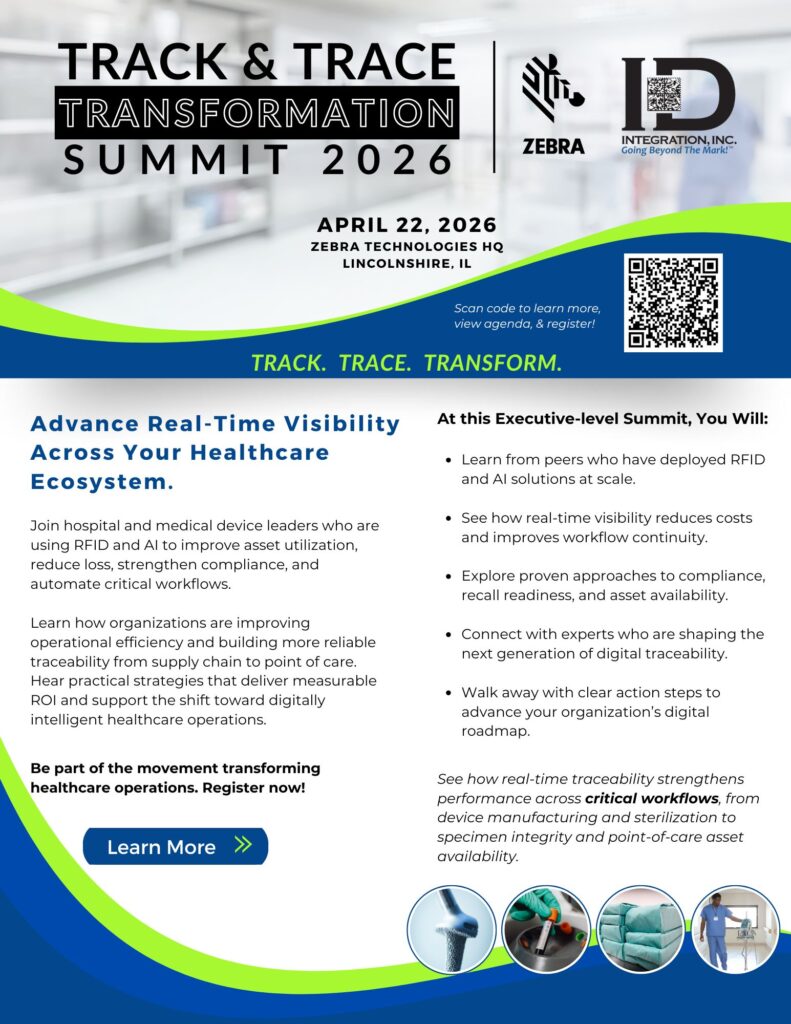
At the Track & Trace Transformation Summit 2026, leaders from perioperative services, pathology, IT, and operations examined how the specimen chain of custody must evolve to support enterprise-scale reliability. The Summit replay provides insight into how organizations are modernizing specimen handoff tracking without adding friction to already strained clinical teams.
Specimen Chain of Custody as Enterprise Infrastructure
The perioperative specimen workflow rarely stays within a single department. A specimen collected in the operating room may move through transport services, laboratory accessioning, pathology review, and enterprise reporting systems. Each transition creates an opportunity for delayed verification, labeling uncertainty, or custody gaps that may not become visible until downstream teams attempt reconciliation.
Summit discussions emphasized that the specimen chain of custody must be treated as enterprise infrastructure rather than as a laboratory-only process. Reliable continuity depends on validating custody events at the moment of transition, not simply documenting them after the fact.
This shift reframes specimen tracking from a compliance requirement to a workflow certainty strategy.
RFID and Automated Specimen Handoff Tracking
Passive RFID was discussed as a practical mechanism for strengthening specimen handoff tracking across departments. By enabling automated confirmation at critical workflow milestones, RFID specimen tracking supports consistent validation without requiring additional manual scanning behavior from clinical staff.
When thoughtfully integrated, this approach can support:
- Real-time confirmation of specimen transfers
- Immediate visibility into custody discrepancies
- Stronger audit defensibility for regulatory review
- Reduced reliance on retrospective reconciliation
Summit participants reinforced that technology alone does not guarantee continuity. Integration with LIS and EHR platforms, clearly defined governance models, and cross-department accountability determine whether automation improves reliability or adds complexity.
Scaling Beyond Department-Level Initiatives
Many health systems have piloted surgical specimen tracking or laboratory-focused custody improvements within contained environments. Scaling those efforts across campuses and service lines requires more than replication. It requires architectural discipline.
The Summit replay highlights how organizations are:
- Aligning perioperative and pathology leadership around shared accountability
- Establishing measurable metrics tied to specimen custody events
- Designing integration pathways that support enterprise reporting
- Avoiding stagnation after early pilot success
As healthcare organizations continue to modernize operational workflows, specimen continuity is increasingly part of broader enterprise visibility and operational resilience strategies. The organizations making the most progress are not simply improving documentation. They are building reliable workflow certainty at every critical transition point.
Expanding the Visibility Conversation
Specimen continuity intersects with surgical workflows, asset movement, sterile processing, and enterprise data integration. Strengthening one domain often requires architectural alignment across others.
If you are exploring broader modernization initiatives, these related resources may provide additional perspective:
Closing the Gaps in the OR: Specimen Chain of Custody Without Added Burden
Why Hospital Tracking Programs Stall and How to Scale Without Starting Over